Are Dual Immersion Programs Good? What Research Says About Bilingual Learning
Yes, dual immersion programs are good for children. Decades of educational and cognitive research show that high-quality bilingual programs support stronger executive function, academic achievement, cultural awareness and long-term cognitive flexibility.
But despite this mountain of research, many parents are hesitant to enroll their children in dual immersion programs. Maybe you’re thinking that your child will get confused and mix up the languages. Maybe you’re worried that their English will suffer, or that it’s too much new information all at once for them to handle.
The good news? Research shows that children’s brains are wired to learn languages, and they’re capable of learning multiple languages at the same time. Study after study shows that the early years are best for language learning.
But why are dual immersion programs good? Let’s explore the effects of dual language immersion programs on student achievement in more detail.
What Is a Dual Immersion Program (And How Is It Different From Traditional Schooling)?
In dual immersion programs, children learn content in two languages. A dual language immersion program is an educational model that teaches academic content in two languages to a classroom of kids.
Within dual immersion programs, there are two types: one-way and two-way immersion.
- One-way immersion (sometimes called full immersion) immerses children from the same language background in another language. For example, a classroom of children from English-speaking homes would be taught in Spanish.
- Two-way immersion (sometimes called dual language) brings together children from both language-speaking backgrounds. For example, a classroom of children from both English-speaking and Spanish-speaking homes would be taught together.
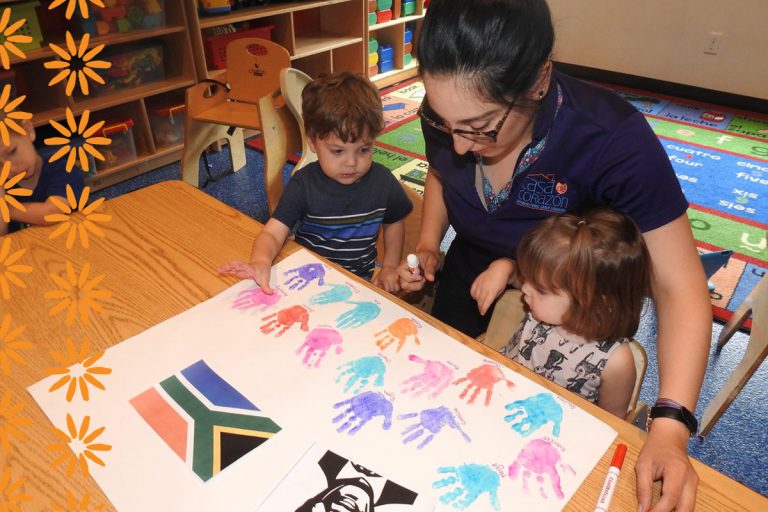
Regardless of the type of dual immersion program, the goal is long-term bilingualism and cultural understanding. It’s not just language class—it’s learning math, science, social skills, and literacy in two languages.
What the Research Says: Are Dual Immersion Programs Good for Children?
Bilingual education research spans decades. Overall, research shows that well-designed dual language immersion programs are beneficial for kids. But those benefits are nuanced, and it’s important to understand them in detail.
One of the most important nuances is that all programs are not created equal. While research shows the many benefits of dual immersion education, it’s clear that those benefits depend on a program that’s well structured. In bilingual education, quality makes all the difference. And at Casa de Corazón, that’s something we live every day.
1. Stronger Executive Function and Cognitive Flexibility
The effects of dual language immersion programs on student achievement are well-documented. Some studies have found that bilingual students show better problem-solving and pattern recognition, as well as stronger selective attention and mental flexibility.
Children learning via a research-based dual immersion curriculum get practice switching between languages, which strengthens the brain’s “management system.” This can help improve focus, task-switching abilities and impulse control—key skills needed as children enter school and learn to emotionally regulate.
2. Academic Outcomes That Match or Exceed Peers
There’s a common myth that learning two languages can cause language delay, but it’s simply not true. Many large studies find that students in dual language immersion programs perform as well as or better than their monolingual peers—especially after the early grades.
Children might experience a small initial lag in English language learning, scoring slightly below peers in kindergarten. Even when that happens, dual immersion students often outperform their peers in English reading and academics by 5th or 6th grade. Yes, that’s right: being immersed in Spanish can help their English skills over time!
These studies show stronger literacy and academic outcomes when children are educated in dual-language programs rather than English-only settings. Some studies have also found that higher math achievement correlates to immersion learning.
3. Social-Emotional and Cultural Benefits
Children who learn in diverse and dual-language classrooms learn greater empathy. Over time, they engage in more effective cross-cultural communication and develop a broader worldview.
At Casa de Corazón, we believe in nurturing children with a child-centered approach that prioritizes diversity, environmentalism and health in a clean and caring learning environment. These Casa Core Values help children and their families foster authentic connections across cultures.
The effects of dual language immersion programs on student achievement are overall extremely positive. Bilingualism isn’t tied to risks; it’s actually correlated with improved academic success. The real issue to look for? Poor-quality programs.
Why Early Childhood Is the Ideal Time for Dual Immersion
Early childhood is the best time for dual immersion education. That’s because young brains are built to absorb language. Did you know that infants are born with the ability to distinguish the sounds of virtually every language on Earth?
Research demonstrates that babies’ brains possess an immense ability to learn language. In early childhood, neural pathways are connecting and reshaping at an astonishing speed. That’s referred to as “brain plasticity.”
Even the youngest babies learn intuitively before self-consciousness develops. Through play and interaction, children acquire language naturally and intuitively. It’s never too early for babies to start learning language, and at Casa de Corazón, we offer infant, toddler, preschool and pre-k programs for each age and stage.
What Makes a Dual Immersion Program Truly Effective?
For a dual immersion program to be truly effective, it must be high-quality. The curriculum must be based on research, and the teachers must love what they do. Here’s what that looks like.
Language-Rich, Play-Based Learning
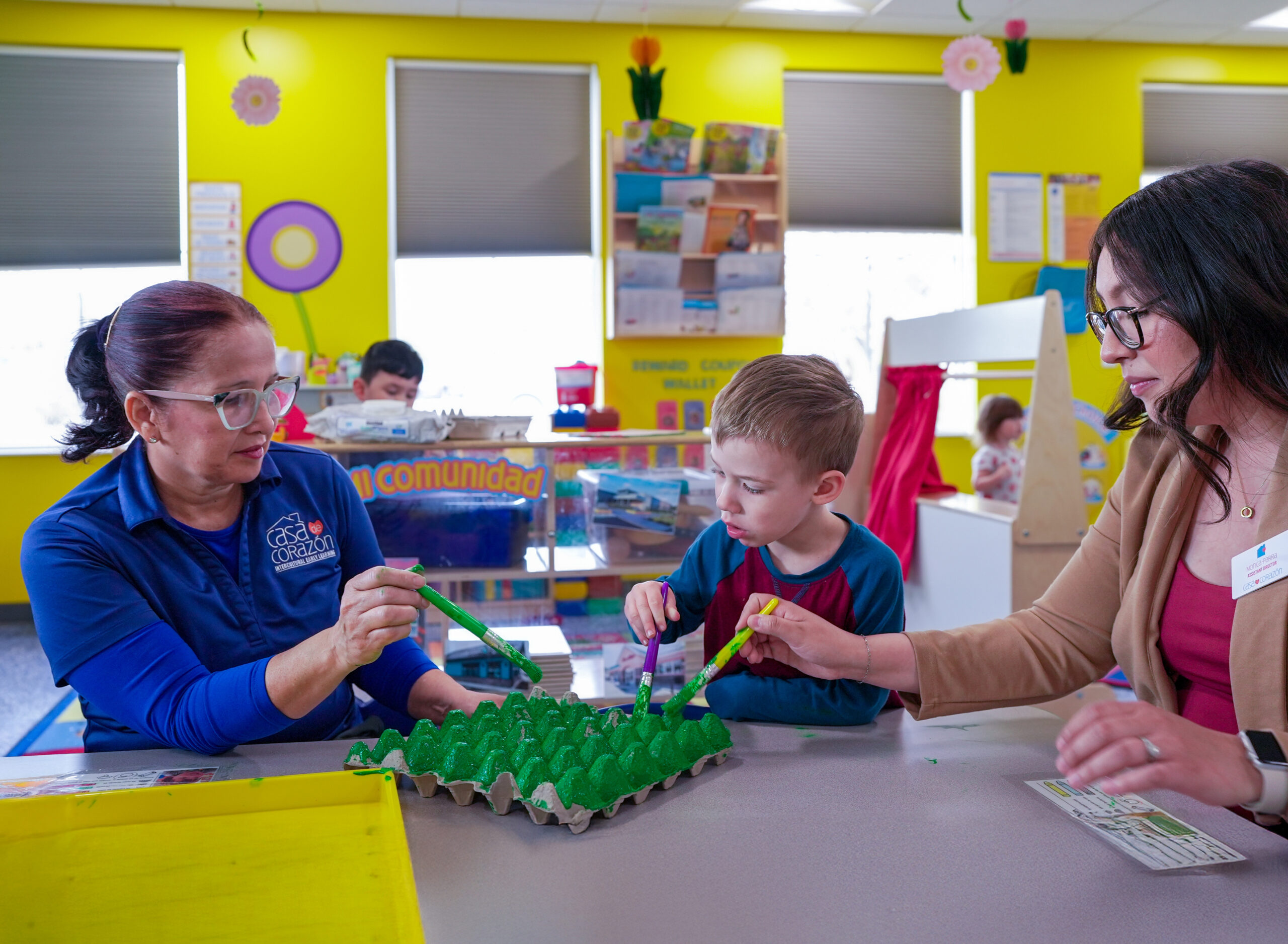
An effective dual language immersion program involves activities such as songs, storytelling and guided play. Children learn songs together and sing them as part of their daily routines, creating meaningful context. Over time, they develop an emotional connection to the language—a love for it that primes them for a lifetime of curiosity and connection across cultural experiences.
Warm, Responsive Teachers
A truly effective dual immersion program is more than just its curriculum. Language learning only sticks when children feel safe and engaged. It’s best when that learning is led by warm, responsive teachers who love what they do.
At Casa de Corazón, our vision drives us to consider all staff, children and parents our extended family. We’re committed to developing caring relationships with every person who comes through our centers.
Research also supports the idea that “back-and-forth” social interaction is key to activating the brain’s motor centers for language development. This includes interactions called “serve and return,” where adults return attention and communications to young children’s “serving”—babbling, gesturing or crying, for example.
Consistency and Daily Exposure
Effective dual immersion programs depend on routines to reinforce language learning. Activities that build language skills are built into everything a child does throughout the day. That includes:
- Mealtime language
- Circle time
- Peer interaction and play
FAQs About Dual Immersion Programs
Are Dual Immersion Programs Good for Young Children?
Research suggests that a child’s early years are best for language learning. Young children’s brains are naturally wired to acquire language. As people age, acquiring a new language requires a lot more effort. Enrolling your child in a dual immersion program at a young age is one of the best ways to start their education.
Do Dual Immersion Programs Confuse Children?
Parents worry that a dual immersion program may confuse their child, but research shows the opposite is true: Instead of confusion, children gain long-term benefits. The truth is that children’s brains are wired to learn languages, and they’re capable of learning multiple languages at the same time.
Children may substitute a word from one language into the other, but that’s perfectly normal. Over time, and as children learn and grow, they discontinue this developmental phase and gain strong proficiency in both languages.
What Is the Difference Between One-Way and Two-Way Immersion?
One-way language immersion (sometimes called full immersion) immerses children from the same language background in another language, while two-way language immersion (sometimes called dual language) brings together children from both language-speaking backgrounds.
Learn more about the difference between one-way and two-way immersion.
What Age Is Best To Start Dual Immersion?
There is no single “right” age to begin dual immersion. Every family and child is different. However, many centers, including Casa de Corazón, begin offering infant care starting at six weeks old.
The Bottom Line: Dual Immersion Is More Than “Good” — It’s Transformative
Dual immersion programs foster bilingualism and long-term high academic achievement. The effects of dual language immersion programs on student achievement have been well documented. All in all, they’re a great choice for your child’s education because they:
- Strengthen cognitive skills
- Support academic achievement
- Build empathy and cultural awareness
- Prepare children for a global future
- Enhance executive function and focus
Are dual immersion programs good? Yes! Come explore our Infant, Toddler, Preschool, and Pre-K programs to see how Casa de Corazón brings bilingual learning to life. Find your nearest location and schedule a tour to experience it firsthand.
Sign up for our newsletter
Related Posts
Tips
How Young Is Too Young to Create a Chore Chart?
As a preschool with award-winning early learning programs, we understand the importance of early childhood development. Chores, in particular, are a great way to encourage learning at home, in addition to everything they learn in our Pre-K program. So, how young is too young to create a chore chart for your little one? It’s younger…
Read More
Franchise Opportunity Innovation
Innovation Highlight: The Casa App
“Casa is moving with the times and making things more user friendly to create better experiences for our families! It is awesome having this app and seeing how everyone’s feedback is making the app even better. ”- Sharon, Edina Center Director Every year, we launch around 5 new breakthrough ideas to positively impact the experience…
Read More
Innovation
Are Eco Friendly Cloth Diapers Better for Infants?
Diapers are a necessary part of life when raising your precious infant. Choosing the type of diaper to use for your child involves consideration of various factors, including personal preference and lifestyle, so it’s essential to research cloth diaper benefits, the types of eco-friendly diapers available, and how they compare to disposable diapers. Understanding your…
Read More