Casa de Corazón welcomes children ages six weeks through pre-K (roughly 4 to 6 years old). We have well-defined programs for all daycare ages that provide age-appropriate Spanish immersion to help kids flourish.
Many times, we’re asked, “Is my baby too young for a structured program?” and “What does ‘age-appropriate’ mean in a bilingual setting?” Parents often worry that their younger children won’t understand the material or that older children will feel out of place.
But don’t worry; we focus on the child’s development, not on age alone. Whether you have a newborn, a curious toddler or a preschooler ready to read, there is a program designed specifically for their stage of development. Let’s explore.
What Age Can Children Start Daycare?
The exact definition of appropriate daycare ages varies by state. In most states, typical daycare age ranges look something like this:
Most licensed centers accept infants starting at six weeks old.
Programs generally serve children up to age 5 or until kindergarten entry.
Some offer extended pre-K for 4- to 5-year-olds.
At Casa de Corazón, our approach is not all about age. A child can transition from one program to another based on milestones and individual behaviors and interests, not just birth date.
A Guide to Daycare Ages at Casa de Corazón
Every age is a different adventure in language and learning. Here is how Casa de Corazón supports each stage.
Infants (6 Weeks–17 Months)—The Foundation of Bilingual Bonding
Placing your child in a bilingual daycare for 1-year-olds and surrounding ages means you’re maximizing their language-acquiring ability right from the beginning. The human brain is best able to learn languages when exposed to them early in life, as we’ve written about.
Casa de Corazón is a safe environment where infants receive nurturing, individualized care. Our teachers build strong bonds through responsive, serve-and-return interactions in both Spanish and English to support development in both languages. Low teacher-to-child ratios ensure each baby receives personalized attention.
Infants explore the world through sensory play, music, baby sign language and hands-on experiences that spark curiosity.
Young Toddlers (12–24 Months)—When Language Comes Alive
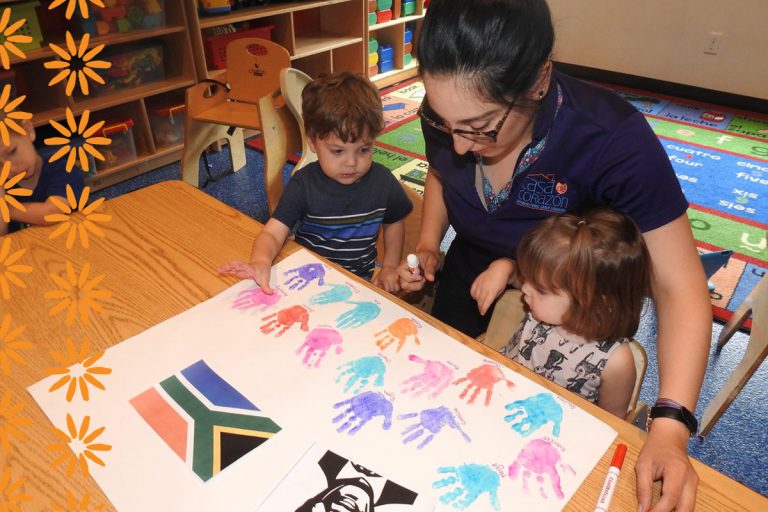
This daycare age range is prime time for language absorption, making it ideal for dual-language exposure. At Casa de Corazón, our toddler daycare curriculum stimulates multiple areas of the brain to help develop vocabulary and comprehension. Naming things, reading, singing songs and having daily routines all help build language.
In addition, 18-month school programs include movement-based learning. Movement encourages children to explore their environment while building physical coordination and confidence. Hands-on play, both independent and directed, helps develop communication abilities and motor skills.
Older Toddlers (16–33 Months)—Building Confidence Through Communication
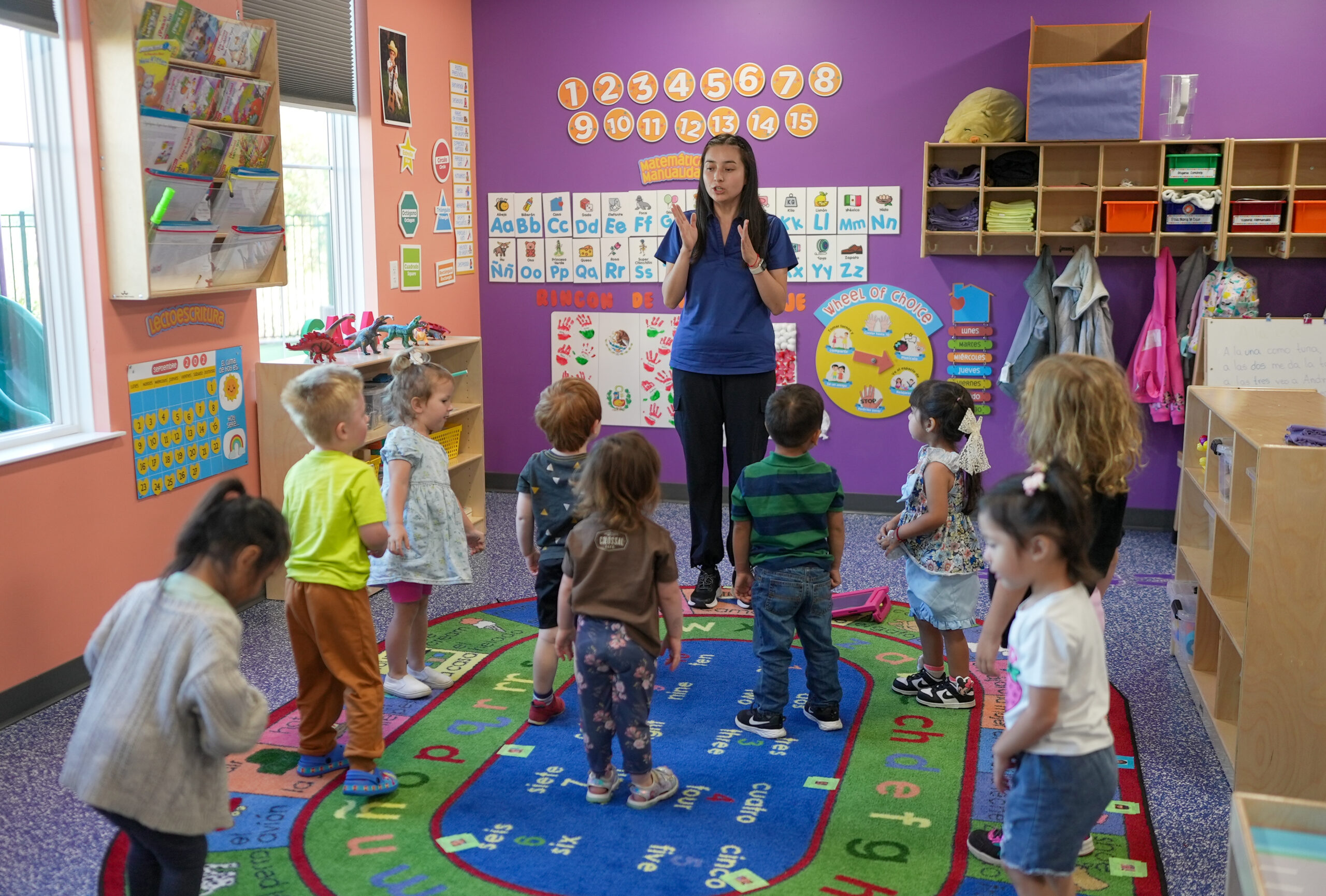
Bilingual daycares for 2-year-olds and 3-year-olds are where we start to focus more on structured communication, activities and routines. We bring Spanish and English learning to life through individual and group activities that are repeatable yet fun and engaging.
At this older toddler age, we’re looking for increased peer interaction that feels natural, not forced. It can be as simple as taking a walk around the neighborhood together and talking about what we see: the houses, birds and trees. Our older toddlers in daycare also learn through engaging activities like puppet shows, singing and all kinds of play.
We want to make sure daily routines reinforce language learning. One example is toilet training, which we support in a bilingual fashion so children can naturally verbalize their need to use the bathroom in both languages. Any routine, from getting food to preparing for a nap, is an opportunity to develop language skills.
Preschoolers (2.5–4.5 Years)—Curiosity Meets Curriculum
Casa de Corazón’s preschool program builds on children’s natural curiosity, using it as the foundation for a thoughtfully designed, play-based curriculum. Students build early literacy and number skills through activities, small group work and guided exploration in Spanish.
Cooperative play is central, helping children practice teamwork and problem-solving with peers. Teachers also prioritize social-emotional learning that encourages empathy, confidence and self-expression.
With a balance of structured learning and creative play, preschoolers develop the skills and mindset needed for a successful transition to the pre-K program.
Pre-K (4–6 Years)—Kindergarten-Ready Bilinguals
We view kindergarten readiness more like lifelong-learning readiness. At this age, we focus on strengthening the bilingual foundation and providing an early learning head start.
That means our teachers help children develop reading, writing and math skills through a bilingual curriculum conducted in Spanish. The goal is to deepen language fluency and confidence.
Importantly, we prioritize communication with families as you get ready to transition your child into kindergarten. As your child leaves Casa de Corazón and enters school, you’ll know that they’ve been prepared to excel, armed with the intellectual advantages that bilingualism provides.
Why Age-Appropriate, Bilingual Care Matters
Human beings acquire language from the earliest daycare ages. Maximizing that language acquisition ability is best accomplished with a curriculum that pairs materials to specific development ranges and ages. Still, brains and learning are not one-size-fits-all, so our teaching isn’t either.
Brain Development Windows by Age
- Ages 0–3: The brain is rapidly developing. It is absorbing sounds and learning to recognize those sounds as words. In literacy, this sound-recognition ability is called phonemic awareness.
- Ages 3–5: By this age, the brain is processing social cues and solving problems. It’s been proven that children who can think in multiple languages are able to reason and solve problems quicker than monolingual kids.
How Casa de Corazón’s Programs Are Designed To Match Each Stage
Casa de Corazón’s NAEYC-approved bilingual curriculum is built to optimize these windows. Our daycare centers help children strengthen their bilingual abilities at every stage.
We do this by ensuring appropriate teacher-to-child ratios for each age group and providing physical and intellectual activities for different daycare ages. We also use monthly learning themes to keep kids engaged as they grow.
Smooth Transitions Between Age Groups
If you’re worried that your child will lose ground when they move to the next daycare age range, don’t be! At Casa de Corazón, we ensure that kids transition from one program to the next based not only on age but on social readiness and comfort.
Your child will still be around the same teachers and classmates as they move through our programs. That familiarity helps the child feel a sense of stability, which is key to avoiding setbacks.
And remember, the goal with moving to the next program is not to treat it like a reset or a fresh start. It’s to build upon the language and skills acquired in earlier programs as a form of gradual growth over time.
FAQs About Daycare Ages
What Is the Minimum Age for Daycare?
The minimum daycare age typically starts around six weeks old, but it varies by state regulations and individual center policies. Casa de Corazón starts kids as early as six weeks, with specific care practices that ensure the safety and development of our youngest pupils.
What Age Is Best To Start Daycare?
There is no single “best age” to start daycare, as it depends on your family’s needs and your child’s development. To maximize language and social development benefits, research supports enrolling children in daycare early in life. Daycare centers allow kids to socialize and get a feel for structured routines with a head start on early learning.
What Age Do Children Leave Daycare for Preschool?
Typically, a child moves from daycare to preschool around age 3 or 4, depending on their readiness. At Casa de Corazón, preschool is part of the daycare journey, so there is no need to switch schools. Since our transition happens within Casa de Corazón, children tend to retain more of their language skills as they enter preschool.
Is There a Benefit to Bilingual Daycare at a Young Age?
Yes! Early exposure to multiple languages improves language acquisition, cognitive flexibility and listening skills. Children of all daycare ages also develop cultural awareness and learn how to communicate with people of different backgrounds. Ultimately, bilingual daycare can lead to a friendly, thoughtful school-aged child.
Ready To Find the Right Program for Your Child’s Age?
Casa de Corazón is a premier Spanish immersion daycare that parents trust to help their children grow into well-rounded students.
- We have programs for kids ages six weeks through pre-K.
- Every age group has a purpose-built bilingual curriculum.
- Transitions between programs are designed to be smooth and supportive.
- Your child can grow with Casa de Corazón from infancy to kindergarten readiness.
We invite you to explore all the daycare ages we serve, including our infant, toddler, preschool and pre-K programs. And we’d love for you to schedule a tour and visit your local Casa de Corazón to see how we can support your child’s bilingual journey!