Why the Distinction Is Becoming Less Relevant
The distinction of daycare vs nursery school is becoming less important as childhood education evolves. The better question now is simply what to look for in an early childhood program.
The best centers offer full-day enrichment programming, regardless of whether they’re a daycare or nursery school. Neither setting is viewed simply as a babysitter anymore, and research has shown that structured learning in full-day settings leads to positive outcomes.
Further, licensing has made the distinction less important. Over time, increased regulations and expectations meant that daycares and nursery schools evolved to meet very similar standards. These days, in many states, the quality and characteristics are nearly the same.
What To Look For in Any Early Childhood Program
Since they’re so similar, looking at daycare vs nursery school won’t make much of a difference. Instead, pay attention to specific qualities and benefits of each program.
Qualified, Caring Teachers
Language and learning thrive when children feel safe and seen. Teachers foster that kind of feeling. Of course, teachers should have the academic qualifications you would expect. But the true value comes in what teachers offer beyond their academic backgrounds.
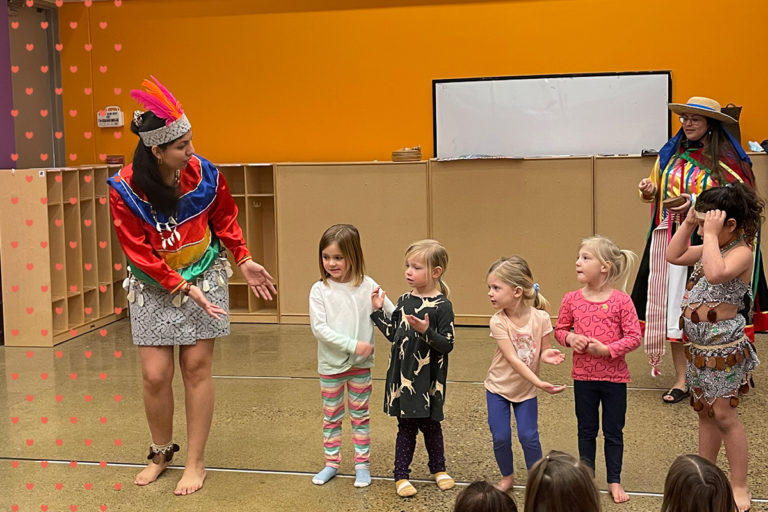
At Casa de Corazón, we hire teachers who view you as part of our extended family. Here, your child’s bilingual journey is centered around the relationship we develop with you and your child. Through these trusting relationships, we can genuinely immerse your child in programs based on our core values.
A Developmentally Appropriate Curriculum
Understanding a center’s curriculum is key to choosing the right location for your child. The curriculum should be tailored to meet your child’s needs, based not only on their age but on their developmental state as well.
If you see a center that prioritizes play-based learning, you should be encouraged by that! Play-based learning is not the absence of structure—it is the structure. Play helps kids retain new information in a positive setting, and play-based interactions help them build both their listening and speaking skills.
Consistency and Routine
Routines, both at school and at home, help children understand what is expected of them, reducing their stress and anxiety while increasing their independence.
Having a routine also frees up the child’s mind to focus on their education. They don’t need to devote mental energy to worrying about something unexpected. Instead, their brains are at ease and focused on learning.
A Bilingual or Language-Enriched Environment (Bonus)
Bringing bilingual education into the picture takes your childcare experience to the next level.
Developing brains are primed to acquire languages easily—far more easily than adult brains. Research shows that humans begin acquiring language skills from infancy. In fact, the earlier children become exposed to languages, the more easily they can understand and eventually speak those languages.
Activating the brain’s language centers helps kids absorb information more readily, leading to academic and cognitive advantages later in life.
How Casa de Corazón Bridges Daycare and Nursery School
We offer families the flexibility to do what is in the best interests of their children. That means we offer full-time daycare as well as part-time educational options that people might traditionally think of as nursery school.
But whether you choose full- or part-time care, the real value we provide lies in our educational depth, delivered with the added benefit of Spanish-language immersion.
Our bilingual, research-backed curriculum is built to fit kids ranging from infants to pre-kindergarten. We offer full-day, year-round availability across several locations for working families. We keep our class sizes small to ensure that teachers and children can build strong, trusting relationships that last all the way through the Casa de Corazón experience.
FAQs: Daycare vs Nursery School
Is Nursery School Better Than Daycare?
Neither nursery school nor daycare is inherently better. The choice depends on variables like quality, staff training, child temperament, schedule needs and educational philosophy. A nurturing environment, consistent routines and engaging activities matter more than labels when supporting a young child’s development.
What Age Is Nursery School For?
Nursery school typically serves young children before kindergarten. Some programs begin as early as 18 months, though most enroll children between ages 2 and4. These early learning settings focus on socialization, play-based activities and foundational skills for development.
Is Daycare the Same as Preschool?
They aren’t necessarily the same. Daycare often focuses on care and supervision, while preschool emphasizes early education. However, many high-quality daycare programs incorporate a full preschool curriculum, blending nurturing care with structured learning experiences.
We’ve also had parents ask, “Is preschool cheaper than daycare?” and it depends on the program. Some preschool programs are cheaper, but those often offer limited hours.
Can a Child Attend Both Daycare and Nursery School?
Yes, a child can attend both daycare and nursery school, often with nursery school in the morning and daycare later. However, scheduling this can be complex. Full-day bilingual programs combine care and education, replacing the need to juggle different arrangements.
The Bottom Line: Great Early Childhood Care Is More Than a Label
Whether a program is labeled daycare vs nursery school is simply not as relevant as what happens within the center. Regardless of label, you should evaluate the program’s quality and approach, its teachers, its curriculum and the way the employees make your family feel.
Casa de Corazón offers your child all the advantages of early education, plus the added benefits that come with early language learning. We would love the opportunity to show you how we combine nurturing full-day care with research-backed bilingual education.
Schedule a tour and find out why Casa de Corazón could be the best fit for your family.