
How To Raise a Bilingual Child: Tips For At-Home Practice
Raising a bilingual child is an exciting and admirable goal—but it can feel a little overwhelming. Many parents wonder if they’re doing “enough.” They worry that the bilingual education might confuse their child. Or they feel unsure about how to support language learning when they don’t speak both languages themselves.
The good news is that bilingualism doesn’t require perfection. Curious how to raise a bilingual child? It just requires consistency, encouragement and meaningful exposure.
In this guide, we’ll explore practical strategies for making bilingualism a joyful, natural part of your child’s everyday life. You’ll learn tips to use at home, and you’ll discover how Casa de Corazón can support your family every step of the way.
Why Raising a Bilingual Child Is a Valuable Gift
Bilingualism is more than just knowing a second language. It’s a valuable gift that will help shape your child’s cognitive, social and emotional development. When children grow up using two languages, they gain skills that extend far beyond words.
Cognitive and Academic Benefits of Being Bilingual
The science of bilingualism is an evolving field. With each new research study, we’re learning more about the cognitive and academic benefits of being bilingual. Studies have shown that children who are exposed to more than one language from an early age often develop stronger problem-solving, memory and multitasking skills.
These skills serve them well academically as they become flexible thinkers and better learners overall. Bilingual children often demonstrate improved attention, stronger reading skills and a deeper understanding of how language works.
Social and Emotional Advantages of Bilingualism
One of the most important benefits of early bilingualism is often taken for granted: bilingual children will know multiple languages, so they experience more chances to connect with the world around them.
Speaking two languages can be important for:
- Travel
- Employment
- Spending time with members of one’s extended family
- Maintaining a connection to family culture and history
- Making friends from different backgrounds
Bilingualism truly opens doors to richer friendships and experiences. It helps children have a broader understanding of the world around them and to be more empathetic to the diverse perspectives of others.
Bilingualism and Future Career Opportunities
In an increasingly global world, speaking more than one language is a powerful asset. Employers across industries value multilingual employees for their communication skills, cultural competence and adaptability.
By supporting bilingualism early, you’re opening doors to academic, professional and personal opportunities you may not even imagine yet.
Best Strategies for Raising a Bilingual Child at Home
If you’re wondering how to raise a bilingual child, remember: It doesn’t require structured lessons or fluency in both languages. What matters most is creating consistent, positive exposure—making language learning part of daily life.
Immersing Your Child in a Language-Rich Environment
Children learn best through meaningful interaction. Surround your child with opportunities to hear and use both languages naturally throughout the day. This may include:
- Reading bilingual books together
- Listening to songs in Spanish and English
- Labeling objects around the house
- Using simple phrases during routines like meals, bath time or getting dressed
The goal isn’t constant translation. It’s creating a routine where both languages feel familiar and safe.
Encouraging Play and Interactive Language Learning
Play is one of the most effective ways children learn language. Games, pretend play and hands-on activities allow children to experiment with new words in a low-pressure environment.
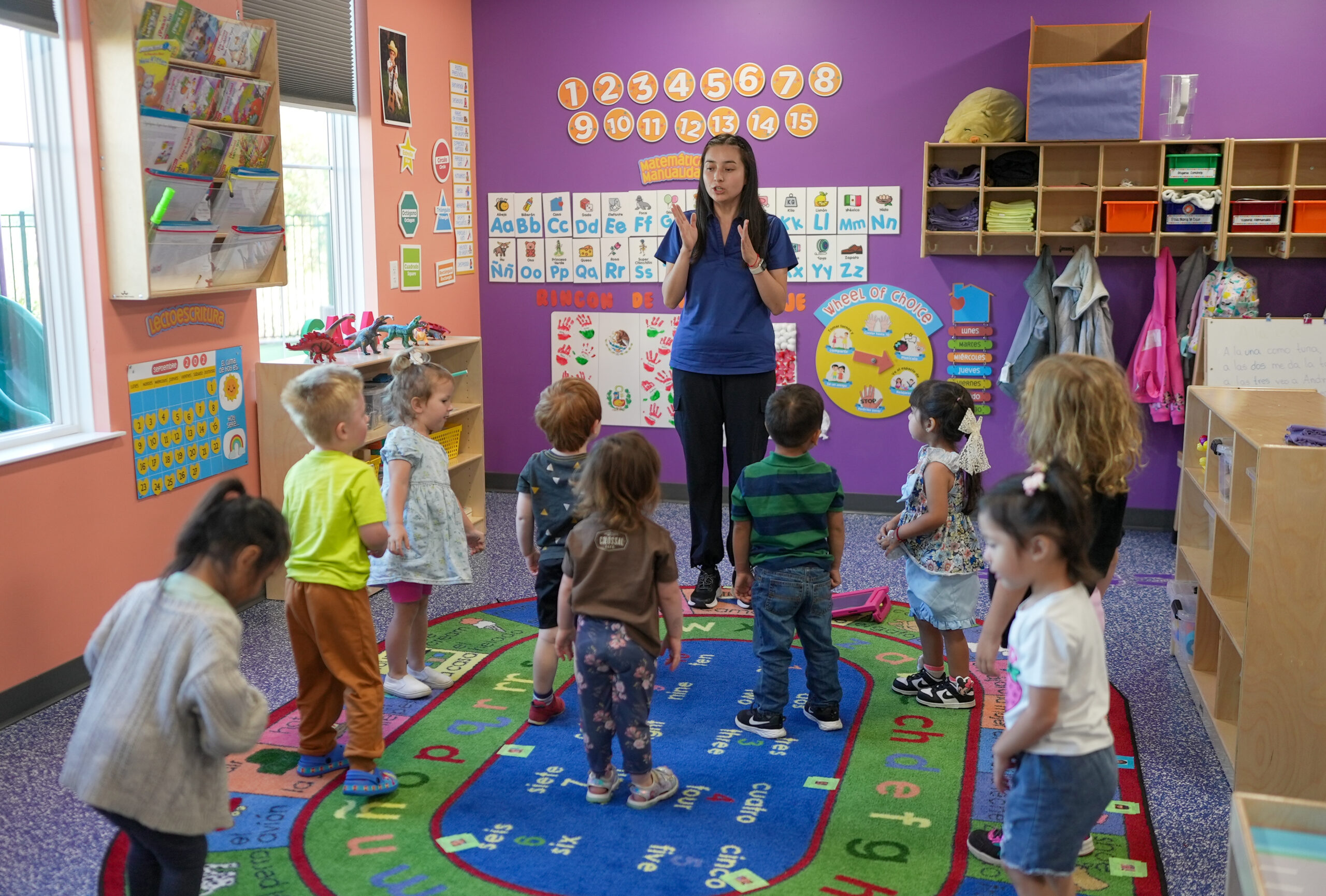
At Case de Corazón, our preschool and toddler programs include music, songs and play. These activities naturally invite children to use new vocabulary and language skills.
We encourage parents to let their kids learn language through play throughout the day—at home as well as with us.
Supporting Bilingualism Through Daily Activities
Language learning doesn’t need to be separate from everyday life. In fact, some of the most powerful learning happens during ordinary moments.
Reading Together: The Power of Bilingual Books
Reading aloud is one of the best ways to support language development. Choose bilingual books that allow children to make connections between languages while building vocabulary and comprehension.
For young learners, choose books with great pictures and simple, repetitive text, like any on this list of 17 Spanish/English bilingual picture books. Your child also might enjoy La Casita, our original children’s book!
The Magic of Songs and Rhymes in Language Learning
Songs and rhymes are very effective for young children, as the repetition helps cement new words and sounds into their memories. Singing in both Spanish and English helps children absorb pronunciation, rhythm and vocabulary naturally.
Don’t worry about singing perfectly. Your enthusiasm matters more than accuracy. Children love hearing familiar songs repeated. It’s those melodies that often become the building blocks of early language learning.
To help, we’ve developed 100 Voices of Casa, a combination of songs and audiobooks created in collaboration with local and international artists. Our songs and audiobooks fill our classrooms and families’ homes.
Using Educational Apps and Technology To Reinforce Language
Many high-quality reading apps are designed for young bilingual learning, offering interactive stories that reinforce both languages. These include Canticos, Lingokids and Gus on the Go.
We recently launched a new version of our innovative project, The Casa App. It’s a great resource for families. Not only does it keep families up-to-date about their child’s day, but it lets them listen to Casa’s classroom music, learn about upcoming events and get to know their child’s teachers.
Speaking to Your Child in Both Languages Throughout the Day
One of the simplest ways to help as you learn how to raise a bilingual child is by talking with your child throughout the day. Using Spanish words during meals, while running errands, at playtime and at bedtime helps make those words comfortable and familiar.
You don’t need to translate everything or switch constantly. Learning short phrases, greetings or songs to repeat each day can make a difference over time
How Immersion Programs Like Casa de Corazón Support Bilingualism
At-home learning is important, but immersion programs play a powerful role in helping children truly live a second language.
The Benefits of a Spanish Immersion Daycare Program
Enrolling your child in a Spanish immersion daycare reinforces the language skills they’re learning at home. From the way we teach to the way kids play, this constant exposure helps language development feel natural rather than forced.
Plus, at Casa de Corazón, we are more than just a language school. We nurture children through:
Our core values:
Children are cared for holistically through meaningful relationships and rich cultural experiences that teach them to live whole-heartedly. Spanish isn’t just taught. It’s lived in every meal, moment and social interaction.
Our curriculum:
The Casa Creative Curriculum uses research-based teaching strategies to foster children’s learning through the effective use of time, play materials, self-initiated learning and creative expression.
Our food program:
At Casa, we make our own food. That’s because we believe that nourishing children’s bodies is just as important as nurturing their minds and hearts.
When To Start Formal Immersion To Maximize Bilingual Development
Early childhood is the ideal time to begin immersion education. Young children are especially receptive to new sounds and language patterns, making it easier for them to develop authentic pronunciation and comprehension.
Casa de Corazón is accredited through the National Association for the Education of Young Children (NAEYC) and Parent Aware. With us, parents can feel confident they’re choosing a high-quality learning environment that supports both language development and overall well-being for their young learner.
Frequently Asked Questions About Raising a Bilingual Child
Is It Normal for My Child To Mix Languages?
Yes, it’s normal for your child to mix languages. Children often use words from both languages to express themselves. Over time, your child will naturally learn when to use each language.
How Can I Tell If My Child is Progressing in Both Languages?
Progress looks different for everyone, depending on your child and the languages they’re learning. Look for milestones like increased vocabulary, understanding instructions and growing confidence.
Can I Raise a Bilingual Child Without Speaking Both Languages?
Absolutely! Many of our families aren’t fluent themselves. Immersion programs give children consistent, high-quality language exposure while families support learning with encouragement, curiosity and connection.
Ready To Start Your Child’s Bilingual Journey?
Visit Casa de Corazón and Schedule a Tour Today
Ready to learn how to raise a bilingual child? Doing so is a meaningful investment in your child’s future.
At Casa de Corazón, children are supported in a nurturing, culturally rich environment where language learning happens naturally. Schedule a tour today to see firsthand how we support bilingual learning from the very beginning.
Explore Our Locations and Learn More About Our Spanish Immersion Daycare Programs
Take a look at our locations to find the closest daycare to you. Explore and ask questions about our different programs to get started!
Sign up for our newsletter
Related Posts
Tips
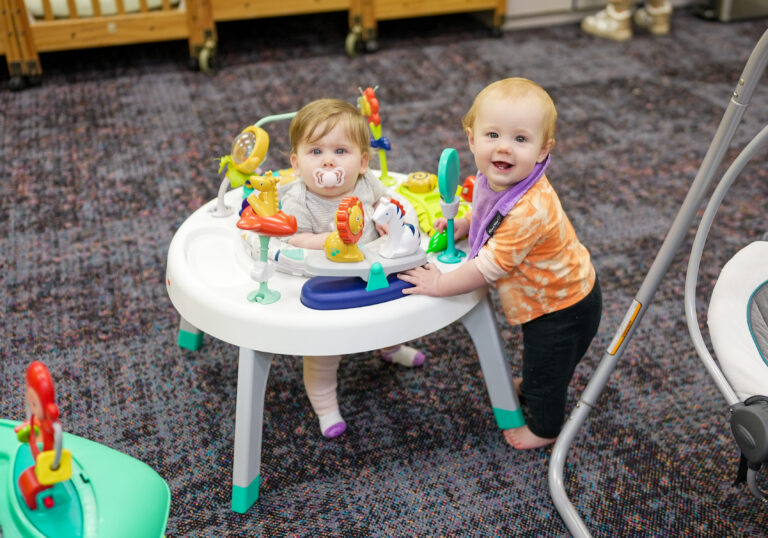
When To Start Looking for Daycare During Pregnancy (and Why It’s Earlier Than You Think)
Becoming a parent is exciting, overwhelming and life-changing. There’s so much to learn—about pregnancy, labor and delivery alone—that figuring out when to get on daycare waitlists may seem a little, well, premature. But you may be surprised to learn that it’s not. Experts recommend beginning your daycare search in the first trimester. This is earlier…
Read More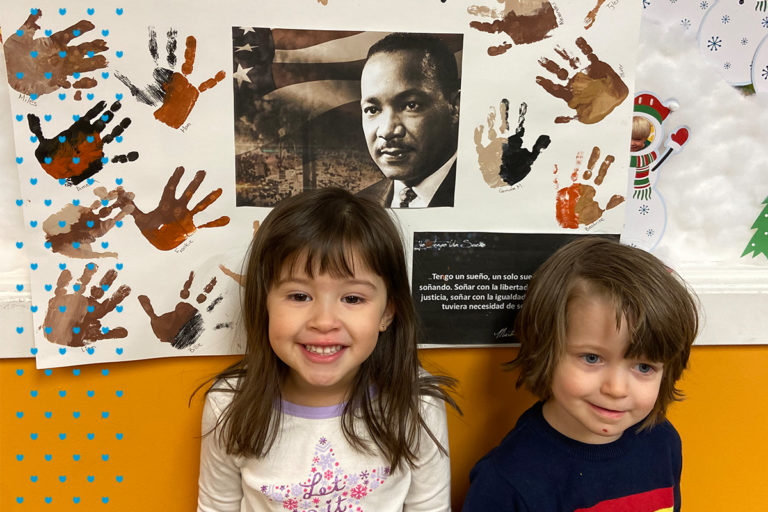
Intercultural Celebrations
MLK Jr. Day and Early Childhood Education
Updated: February 21, 2023 Martin Luther King Jr. Day (MLK Jr. Day) is a special day where we have the opportunity to reflect on important messages and the world’s current situation. You might wonder how you should handle this day of discussion with your child, so we will take a moment to go over some…
Read More
Art & Music
Family Vision Boards
With the new year upon us, families are looking for creative ways to set goals and make them stick. Whether you have a couple of toddlers or teenagers, a family vision board is something that works for family members of all ages. Get together and create one as an entire family and let each family…
Read More